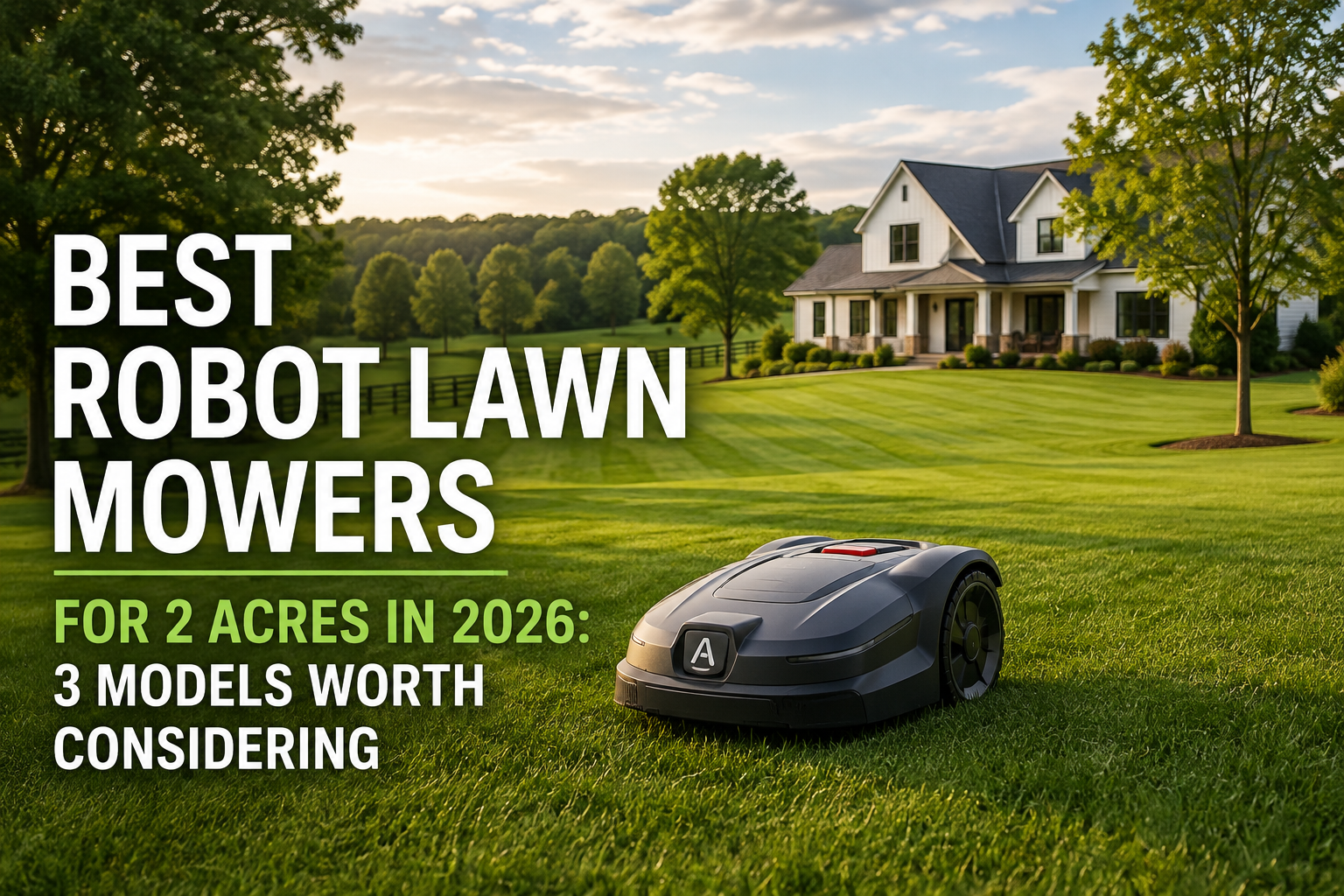
Maintaining two acres of grass can turn mowing into a weekly commitment. A capable robotic lawn mower can take much of that work off your hands, but shopping for one isn’t as simple as picking the mower with the highest acreage number on the box.
Two-acre properties present challenges that smaller lawns don’t. Battery capacity matters more. Navigation needs to be reliable across a much larger area. Trees, buildings, slopes, driveways, separate mowing zones and weak satellite reception can all affect performance.
We researched today’s large-property robotic mowers, comparing manufacturer specifications, coverage ratings, navigation systems, terrain capability and features to identify the models that make the most sense for homeowners trying to maintain around two acres.
Disclosure: This page contains affiliate links. As an Amazon Associate I earn from qualifying purchases.
Quick Picks
BEST OVERALL:
Husqvarna Automower 440 iQ
BEST WIRE-FREE:
Segway Navimow X390
BEST FOR ROUGH TERRAIN:
Yarbo Lawn Mower Pro
| Model | Acres | Slope | Best For |
| Husqvarna 440 iQ | Up to 2 acres | 45% | Overall |
| Segway Navimow X390 | Up to 2.5 acres | 50% | Wire-Free |
| Yarbo Lawn Mower Pro | Up to 6 acres | 70% | Rough Terrain |
1. Husqvarna Automower 440 iQ — Best Overall
For homeowners specifically shopping for a robot mower for approximately two acres, the Husqvarna Automower 440 iQ is one of the most natural places to start.
Husqvarna rates the 440 iQ for up to 2 acres when using systematic mowing. The company rates irregular-pattern capacity at 1 acre, which is an important distinction if you’re buying specifically for a large property.
The 440 iQ uses Husqvarna’s EPOS satellite-based positioning technology, allowing virtual boundaries rather than requiring you to bury perimeter wire around a large lawn. Physical boundary-wire operation is also supported.
It can handle slopes of up to 45% inside the mowing area and offers an adjustable cutting height from approximately 1 to 4 inches. Husqvarna lists typical mowing time at about 138 minutes per charge.
Through the Automower Connect app, owners can adjust mowing schedules and cutting height and choose mowing patterns including stripes and checkerboard patterns. GPS theft tracking and an anti-theft alarm are additional advantages for an expensive machine that spends most of its life outdoors.
Husqvarna also advertises a four-year warranty for this model.
PROS
- Specifically rated for systematic mowing of up to 2 acres
- Wire-free virtual boundaries
- Established robotic-mower manufacturer
- Up to 45% slope capability
- App-controlled schedules and cutting height
- Multiple systematic mowing patterns
- GPS theft tracking
- Four-year advertised warranty
- Hose-washable design
CONS
- Premium purchase price
- Two-acre rating depends on systematic rather than irregular mowing
- Satellite-based positioning can make property layout and signal conditions important
- Extremely steep properties may require a more terrain-focused machine
Who should buy it?
The Automower 440 iQ makes the most sense for someone with a large residential lawn who wants a mower designed around the two-acre mark without moving into an even larger commercial-style machine.
2. Segway Navimow X390 — Best Wire-Free Choice
The Segway Navimow X390 provides a little more advertised capacity than the Husqvarna, with Segway rating it for lawns up to 2.5 acres. That extra headroom is appealing because a homeowner with roughly two acres isn’t operating right at the machine’s advertised maximum.
The X390 uses Segway’s EFLS 3.0 positioning system, combining RTK satellite positioning with visual positioning technology. The system is designed to provide precise navigation without requiring a buried boundary wire.
Segway lists maximum slope capability at 50%, or about 27 degrees. Its cutting height ranges from approximately 2 to 4 inches, with a 9.3-inch cutting width.
The X390 also uses a six-blade cutting system and includes obstacle-detection and app-based mapping features.
For a two-acre homeowner, the biggest attraction is simple: 2.5 acres of rated capacity with wire-free navigation.
PROS
- Rated for up to 2.5 acres
- Extra capacity beyond a typical 2-acre lawn
- No buried perimeter wire
- EFLS 3.0 positioning technology
- Up to 50% slope capability
- AI-assisted mapping and obstacle detection
- App-based management
- Six-blade cutting system
- Designed specifically for large lawns
CONS
- Premium purchase price
- Satellite positioning performance can depend on property conditions
- Heavily wooded or unusually complex properties may present navigation challenges
- Newer robotic-mower platform than Husqvarna’s long-established Automower line
Who Should Buy It?
The X390 is especially compelling for homeowners who want a modern, wire-free robotic mower and prefer a machine rated somewhat beyond their actual two-acre mowing requirement.
3. Yarbo Lawn Mower Pro — Best for Rough Terrain and Large Properties
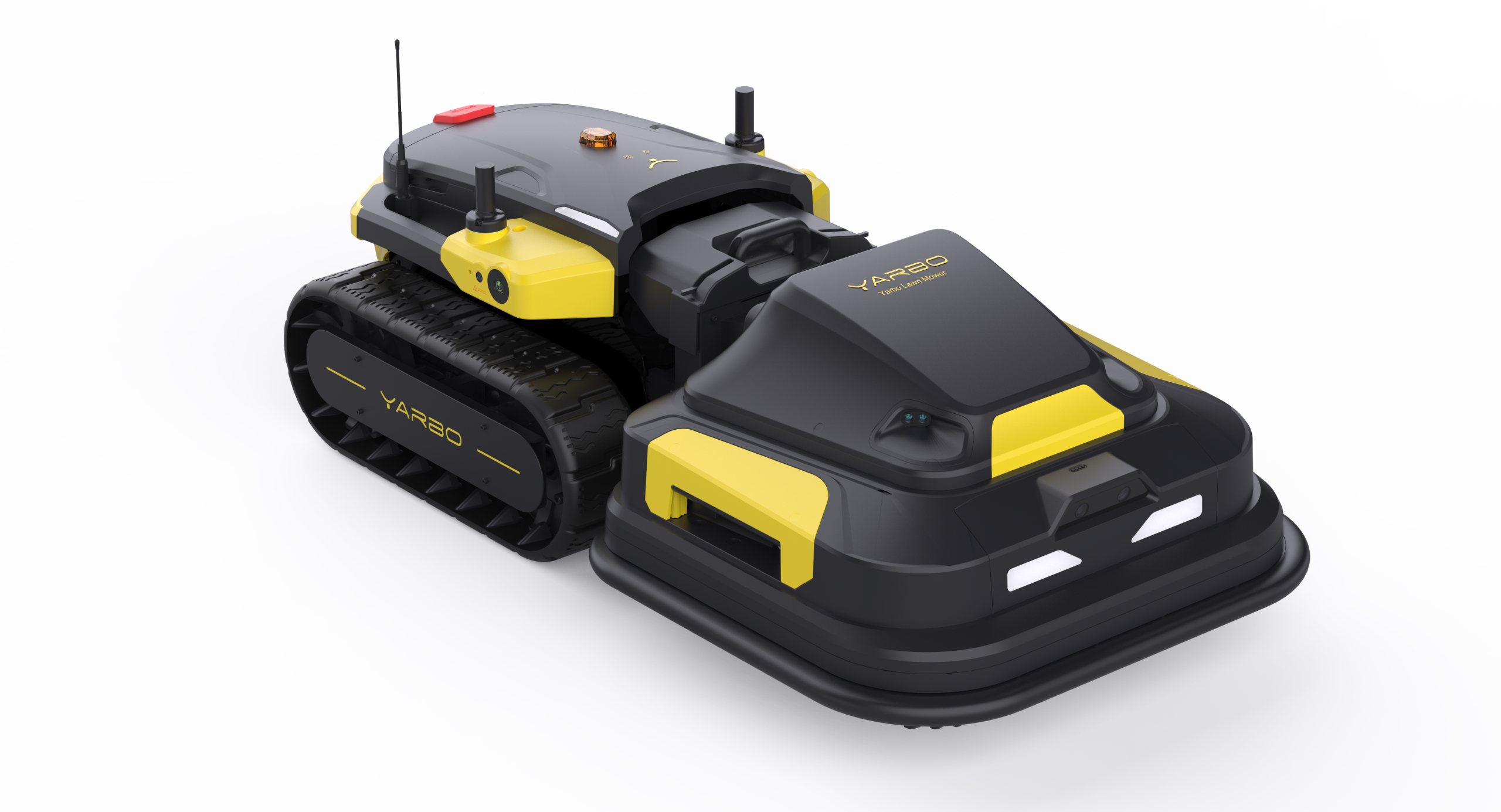
Yarbo approaches robotic mowing differently.
Instead of building a relatively small robot dedicated only to cutting grass, Yarbo uses a larger modular robotic platform designed for demanding property maintenance.
The Lawn Mower Pro is rated to cover up to 6 acres, substantially more than the other machines in this guide. Yarbo says it can tackle slopes up to 70%, or about 35 degrees, and uses RTK positioning combined with multiple sensors for navigation and obstacle detection.
The Pro mower uses dual 300-watt mowing motors and can be configured with cutting discs or straight blades. Yarbo specifically positions the system for demanding conditions including thick, wet and dense grass.
That makes Yarbo especially interesting for properties where “two acres” does not mean two acres of perfectly flat suburban turf.
A hilly rural property with rough areas and multiple mowing zones is a very different job.
For a simple, flat two-acre lawn, however, Yarbo’s six-acre capability may be more machine — and more expense — than necessary.
PROS
- Rated for up to 6 acres
- Excellent capacity for larger properties
- Up to 70% slope capability
- RTK plus multi-sensor navigation
- Powerful dual mowing motors
- Designed for difficult grass and terrain
- App-controlled
- Modular property-maintenance platform
CONS
- Likely overkill for a straightforward two-acre lawn
- Larger and more complex system
- Premium investment
- Buyers who only need lawn mowing may not benefit from the modular platform
Who Should Buy It?
Consider Yarbo if your two-acre lawn is only part of a larger property, you have substantial slopes or rough terrain, or you want significantly more capability than a conventional robotic mower provides.
What About the Mammotion LUBA 3 AWD?
Mammotion’s LUBA 3 AWD deserves attention because its all-wheel-drive design is especially interesting for difficult terrain.
The current LUBA 3 AWD lineup can tackle very steep slopes and uses a combination of LiDAR, RTK positioning and camera-based vision for navigation.
But there’s an important issue for this particular guide: the current LUBA 3 AWD models we reviewed are rated for less than a full two acres of mowing coverage.
That’s why we are not naming the LUBA 3 AWD as one of our primary recommendations for someone who genuinely needs to mow two full acres.
It may still be an excellent option for a property that totals two acres but has a smaller actual mowing area after subtracting the house, driveway, woods, garden or other non-grass areas.
How to Choose a Robot Lawn Mower for 2 Acres
Two acres equals approximately 87,120 square feet. That is a lot of grass, and buying based on features alone can be an expensive mistake.
1. Measure Your Actual Mowing Area
Owning two acres does not necessarily mean you have two acres of lawn. Your house, garage, driveway, woods, garden, pool, barn and other areas may substantially reduce the amount of grass the mower actually needs to maintain.
A two-acre property might have only one acre of mowable grass, and that distinction can dramatically change which robot mower you need.
2. Don’t Buy Right at the Limit
Manufacturer acreage ratings are useful comparison points, but they should not be treated as guarantees that every property of that size will produce identical results.
A flat rectangular two-acre lawn is much easier to maintain than two acres divided into several zones with trees, narrow passages and steep hills.
Whenever possible, having some capacity beyond your actual mowable acreage gives you useful breathing room.
3. Consider Your Terrain
Slope capability varies significantly between robotic mowers. If your property is hilly or uneven, pay close attention to the manufacturer’s maximum slope rating and whether that rating applies throughout the mowing area or only in certain conditions.
4. Look at Trees and Buildings
Many modern robot mowers rely heavily on satellite positioning. That is convenient because you may not need buried perimeter wire, but heavily wooded areas and spaces close to buildings can sometimes make positioning more challenging.
5. Think About Multiple Zones
Many acreage properties are not one giant uninterrupted lawn. You may have grass in front of the house, behind it, around an outbuilding or on the other side of a driveway.
For these properties, reliable multi-zone mapping can be just as important as total acreage capacity.
6. Consider Warranty and Support
A robotic mower capable of maintaining two acres is a significant purchase. Check warranty coverage, replacement blades, battery availability, repair options, firmware support and access to service before choosing a mower based only on specifications.
Is a Robot Lawn Mower Worth It for 2 Acres?
It certainly can be.
The strongest argument isn’t that robotic mowing is cheaper than every alternative. It’s time.
Traditional mowing of a large property can consume hours throughout the growing season. A robot mower turns much of that work into an automated maintenance task.
Robotic mowers also work differently from conventional lawn tractors. Rather than waiting for the grass to become tall and then removing a large amount at once, they can mow frequently and remove small amounts of growth.
But the economics depend on your situation.
If you already own a reliable zero-turn mower and enjoy mowing, spending several thousand dollars on a robot may be difficult to justify.
If you’re considering purchasing a new riding mower anyway — or paying a lawn service throughout every growing season — the calculation becomes much more interesting.
Robot Mower vs. Zero-Turn Mower for 2 Acres
A zero-turn mower and robotic mower solve the same problem in very different ways.
A zero-turn gives you speed, control and the ability to deal with grass on your schedule. But you still have to mow it.
A robot trades some of that control for automation.
For homeowners whose biggest complaint is losing several hours to lawn maintenance, that is a meaningful difference.
Choose a robot mower if your priority is reducing the amount of time you personally spend mowing.
Choose a zero-turn if you prefer direct control, regularly deal with unusually tall or rough grass, or want one machine you can personally operate whenever necessary.
Some large-property owners may ultimately find that the ideal solution is both: a robot for routine grass maintenance and conventional equipment for occasional heavy work.
Our Verdict
For a typical residential property with approximately two mowable acres, the Husqvarna Automower 440 iQ is our best-overall starting point. Its two-acre systematic mowing capacity, virtual-boundary capability, app controls and four-year advertised warranty make it a strong match for the job.
The Segway Navimow X390 may be the more attractive choice for buyers who want additional capacity. Its 2.5-acre rating gives a two-acre property some extra breathing room, while its wire-free navigation and 50% slope capability make it a compelling alternative.
For difficult rural terrain or properties that extend well beyond two acres, the Yarbo Lawn Mower Pro is the heavy-duty option, with up to six acres of advertised coverage and substantially greater slope capability.
The right choice ultimately depends on more than acreage. Measure the amount of grass you actually mow, consider your slopes and obstacles, and pay particular attention to navigation conditions before spending several thousand dollars.
Frequently Asked Questions
Can a robot lawn mower really mow 2 acres?
Yes. Several current robotic mowers are designed for approximately two acres or more. The Husqvarna Automower 440 iQ is rated for up to two acres using systematic mowing, while Segway rates the Navimow X390 for 2.5 acres.
Do robot mowers need boundary wires?
Not necessarily. Modern systems including the Husqvarna 440 iQ and Segway Navimow X390 support wire-free navigation using satellite-based positioning and virtual boundaries.
Can robot lawn mowers handle hills?
Yes, but capabilities vary considerably. Always compare the manufacturer’s slope rating with the steepest parts of your actual mowing area.
How much robot mower capacity do I need for a 2-acre property?
Measure your actual grass area, not simply the acreage of your parcel. Buildings, driveways, woods and gardens do not need mowing. If you truly have approximately two mowable acres, look for a model rated for at least that amount and consider extra capacity if your lawn is unusually complex.
Will a robot mower replace a lawn tractor completely?
For routine grass cutting, it potentially can. But owners of acreage may still want conventional equipment for overgrown areas, hauling, leaf cleanup or other property-maintenance jobs.
How We Chose These Mowers
The Acre Guide evaluates products based on their suitability for the job rather than simply creating the longest possible list.
For this guide, we compared manufacturer-stated mowing capacity, navigation technology, slope capability, cutting system, property suitability, warranty and support information, and other specifications relevant to large lawns.
We have not personally tested every mower in this guide. Our recommendations are based on research of currently available manufacturer information and product specifications. We encourage buyers to verify current specifications, compatibility, warranty terms and pricing before purchasing.
Affiliate Disclosure
The Acre Guide may earn a commission when you purchase through links on this page, at no additional cost to you. Our recommendations are based on our research and are not influenced by the commission we may receive. As an Amazon Associate I earn from qualifying purchases.